

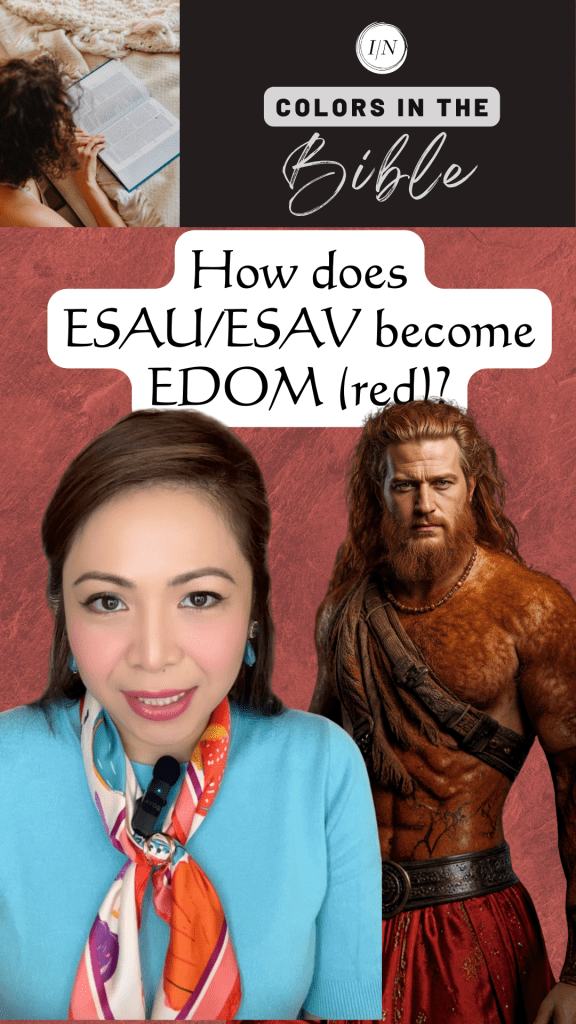
Welcome back to my series, Colors in the Bible. In my last post, we explored the biological “redness” of Esau—his likely high concentration of pheomelanin and his distinct, hairy appearance. But as we follow Esau’s story, we realize that “Red” wasn’t just a birthmark; it was a recurring theme that defined his life, his choices, and his descendants.
The “Red-Red” Impulse
The most famous turning point in Esau’s life involves a bowl of lentils. After a long, exhausting day of hunting, Esau returns home “famished.” His brother Jacob, the domestic twin, is busy simmering a pot of stew.
In Genesis 25:30, Esau’s demand is primal. In the original Hebrew, he doesn’t even say “red stew.” He says, “ha-adom ha-adom ha-zeh”—literally, “Give me some of that red-red!”
From a color expert’s perspective, this is fascinating. The color red is known to:
- Stimulate Appetite: It’s no coincidence that many modern fast-food brands use red; it triggers a physical hunger response.
- Signal Urgency: Red demands immediate attention.
Esau was so ruled by his immediate, “red” impulses that he didn’t even name what he wanted to eat. He just saw the color and demanded it. In that moment of red-hot hunger, he traded his sacred birthright—the spiritual inheritance of Abraham—for a single meal.
From Esau to Edom: It was following this exchange that Esau earned the nickname Edom, which literally means “Red.”
Geography of a Color: The Mountains of Seir
The theme of red follows Esau’s bloodline long after he leaves his father’s tents. His descendants, the Edomites, settled in a region called Mount Seir.
If you’ve ever visited modern-day Jordan (as I did about a decade ago), you’ll see that the landscape is a breathtaking study in geology and color. The region is famous for its red sandstone formations.
Isn’t it incredible? The man born “red,” who threw away his future for “red stuff,” ended up founding a nation in a “red land.” In Hebrew, the word for “red” (adom) shares the same root as the word for “earth/ground” (adamah). Esau was, in every sense, a man of the earth—rugged, impulsive, and tied to the physical world.
Divine Design or Personal Choice?
As a color professional, I’m often asked if color dictates our mood or if we choose colors that reflect our mood. In Esau’s life, we see both.
- The Divine Design: God knew before Esau was born that he would be a man of “red” vitality.
- The Personal Choice: Esau used his “red” energy—his passion and strength—to live for the moment rather than for the eternal.
Esau’s story is a powerful reminder of Free Will. We all have “colors” in our lives—talents, physical traits, or strong personalities. The question is: Will we use those gifts with wisdom and discernment? Or will we, like Esau, squander our “birthright” (our purpose) to satisfy a temporary craving for the “red-red” things of this world?
Watch the Video
See the red rocks of Jordan and hear more about Esau’s legacy in the full video below!


