
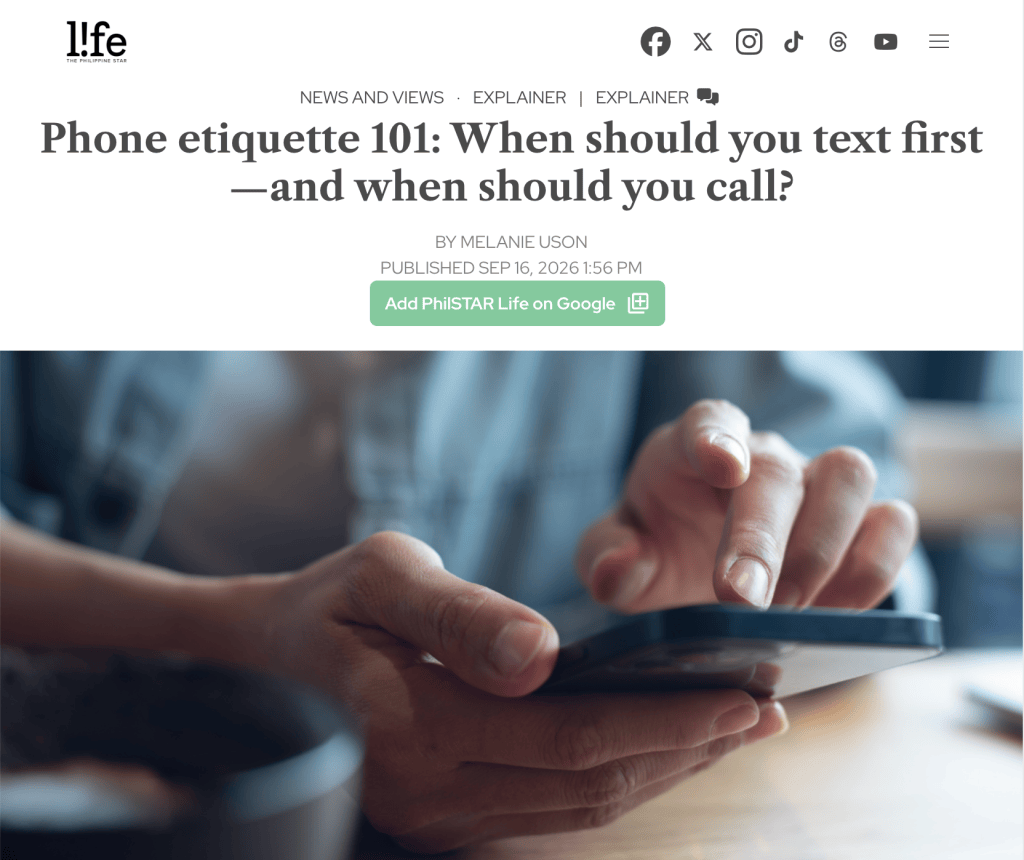
Our phones have made it possible to contact almost anyone, almost anywhere, at almost any time.
But greater access does not necessarily mean greater availability.
I recently shared my insights with PhilSTAR Life for its feature, “Phone etiquette 101: When should you text first—and when should you call?” The article explores an increasingly relevant question in modern communication: how do we balance convenience and accessibility with respect for another person’s time, privacy and boundaries?
Text First—or Call?
There is no single rule that applies to every relationship or situation.
Whenever possible, I believe it is considerate to understand how another person prefers to communicate. Some people are comfortable receiving spontaneous calls; others prefer a quick message first.
A simple “Are you free for a call?” allows the recipient to indicate whether it is a convenient time.
Text messages are useful for quick questions, updates, reminders and details that can be communicated clearly and concisely.
But not every conversation belongs in a text thread.
Sensitive or nuanced matters—particularly those that may be easily misinterpreted without vocal tone or immediate clarification—can often be handled more thoughtfully through a phone call or proper conversation.
Being Reachable Does Not Mean Being Available
One of the realities of modern technology is that we can appear constantly accessible.
That can easily create the expectation of an immediate response.
Good etiquette recognizes that another person may be working, resting, attending to family, in a meeting, or simply unable to take a call at that moment.
Declining a call is not necessarily discourteous. What matters is how both parties handle it.
When possible, acknowledge the missed or declined call and give the caller some context. Likewise, if someone tells you it is not a convenient time, respect that rather than repeatedly calling.
In professional environments, teams can also benefit from establishing clearer expectations around communication channels, response times, urgent matters and after-hours contact. When working across countries, time zones should also be considered.
Courtesy Applies to the Environment Around You, Too
Phone etiquette is not only about the person on the other end of the line.
It includes the people physically around us.
Keep your volume appropriate in public spaces. Avoid discussing confidential or deeply personal matters where others can easily overhear them. And always ask permission before putting someone on speakerphone.
When contacting someone for the first time, introduce yourself clearly, explain how you obtained their contact information when appropriate, and state the purpose of your message or call.
These are small gestures, but they communicate something larger:
I recognize that your time, privacy and attention deserve consideration.
Modern Etiquette Is Still About People
Technology will continue to change the way we communicate: The platforms may change, the speed may change, our habits will certainly change, but the purpose of etiquette remains remarkably consistent.
It asks us to consider not only what is convenient for me, but also what is considerate of the person receiving my communication.


